comics
The Joke That Got Out: How Two Roommates Made the Turtles in 1984
A doodle made to get a laugh in a Dover living room, a loan from an uncle, and a black-and-white book that never once explained that it was a joke.
In the autumn of 1983 Kevin Eastman and Peter Laird shared a studio in Dover, New Hampshire, which was also their living room. One working night Eastman drew a turtle with nunchaku to make his friend laugh.1 It is tempting to tell that as a flash of genius, but the plainer version is the more useful one: the drawing was meant for a single reader, and it landed because that reader was another cartoonist who knew which comics it was teasing.
Laird answered with a turtle of his own. Eastman then pencilled a team of them, each carrying a different weapon, and Laird inked the page and added “Teenage Mutant” to the logo.2 The idea needed a backstory, they decided the next day, and by Eastman’s telling they built one as a homage and a parody of the comics they admired, working on it through the winter.
What they were making fun of
The targets were not hidden. The first issue pastiches The New Mutants, Cerebus, Ronin and Daredevil. The Foot Clan is a send-up of Daredevil’s ninja enemies the Hand, and the rat who trains the Turtles has a name that parodies Stick, the blind teacher in the same book.3 “Teenage Mutant Ninja Turtles” is a title assembled from the covers of its moment, a mutant team book and a ninja book fused into the least likely animal anyone could think of.
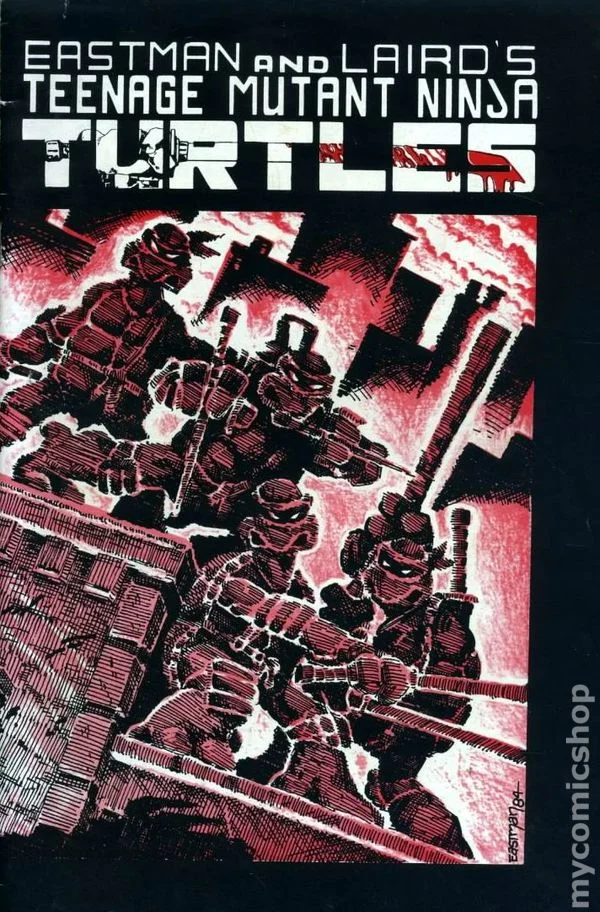
What matters is what the partners did with that title once they had it. They could have drawn a broad comedy, a funny-animal book with a wink on every page, and the cartoon of 1987 would later go in that direction with great success. They drew something else; it was an origin story of mutation and revenge, drawn in black and white and played with a straight face. The book is about a joke that is never explained, a parody that behaves for the length of its pages as if the premise were perfectly sober, and that refusal to wink is what turned a gag into a franchise.
Everything after this rests on that point. When later versions of the Turtles go wrong, they usually go wrong by explaining the joke, and when they go right, as the 1990 film and the 2003 series both tried to do, they go back to a straight face.
Mirage Studios, a loan and a convention
The business behind the joke was small and a little frightening. A report in Foster’s Daily Democrat of Dover, published the day before the debut, describes a studio working out of a Union Street apartment. The paper reports a production bill of $1,100 for the first run.4 Eastman told the paper it was touch and go for a while, until a loan from his uncle, Quentin Eastman of Portland, Maine, made the printing possible. Retellings since then give the loan and the costs in different amounts, so we have kept to the figures the paper printed at the time.
The plan was modest: sell copies at the next Portsmouth Mini-Con, which was being held at a Howard Johnson’s Motor Lodge, sell the rest by mail, and hope that distributors would order more. The partners were already leaning on the direct market, the network of comic shops that buy books without the right to return them, which suited a publisher with no money to absorb unsold stock. The book debuted at that show on May 5, 1984, in an oversized format on cheap newsprint. The early printings share that shape, and our catalogue notes it because collectors can tell those copies from later ones by size alone!
Demand answered quickly, and the evidence is on our own shelves. The catalogue lists issue one through several printings, and the early issues of the series were reprinted more than once, in a business where a self-published first issue normally sells through once and disappears.5 Success was quicker than anyone could have planned for. Within months the early issues were trading for many times their cover price, and a speculation boom in black-and-white comics followed, which the Turtles led and then, as speculation does, outlived only barely. The market for those books collapsed within a few years, yet by then a toy company and a television producer had noticed what the little paper-covered book was doing.6 Our feature on the Playmates line picks up the story from there.
The long middle
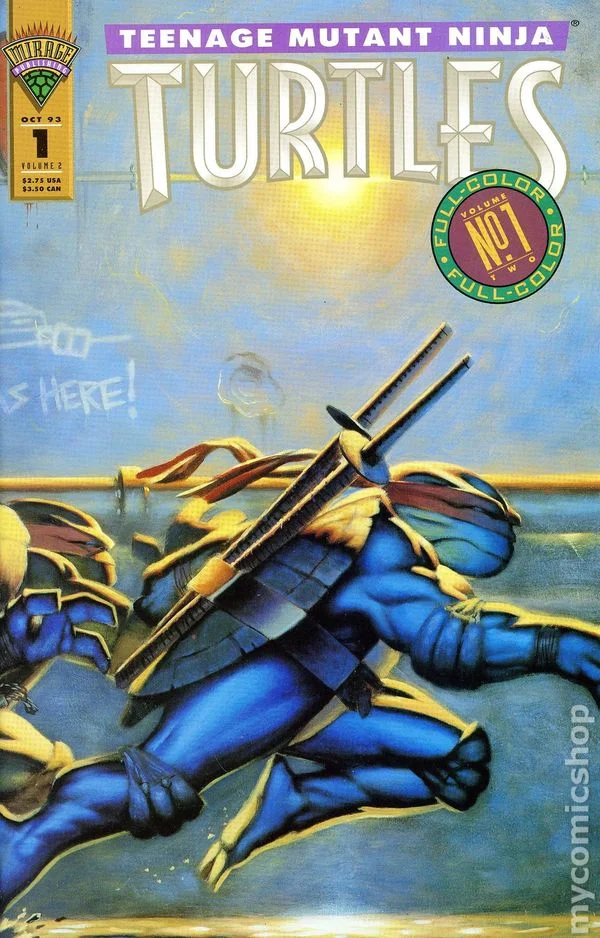
The first volume carried on into the early nineties and passed through the “City at War” storyline before closing in the summer of 1993. Mirage relaunched the book that autumn, but the second volume was short.7 Image Comics took over for a third volume in the middle of the decade, and Mirage came back with a fourth series in 2001 and a Tales of the TMNT anthology beside it. Every one of those series has a page in our Mirage hub, with covers and issue lists.
The most telling thing about that period is how far apart the Turtles became. The cartoon, the toys, the films and the lunchboxes all belonged to the Turtles of 1987, while the comic went on being a black-and-white book from the two people who had drawn the first page.
Where it ended up
Laird sold the franchise rights to Viacom, the parent company of Nickelodeon, in 2009. IDW secured the comic publishing rights soon after and launched its own series, which is the book to read after this one if you want the same characters in a modern shape.8 Mirage Studios itself closed in 2021.
It is a fitting end for a company founded to publish one joke. The studio outlasted the boom it caused, the cartoon it licensed, the films and the toy shelves, and what survives of it is a first issue that still feels like something two friends made because they thought it would make each other laugh. If you want to see where a franchise began, read that issue with the cartoon fresh in your mind and watch how long the book goes without telling you what to think. Kevin Eastman has his own page in our artist series for the rest of his career, and the full issue-by-issue catalogue is open to anyone who wants the covers.
Footnotes
-
Eastman’s description of the evening, including the studio-in-the-living-room detail, comes from his own account as quoted in Bleeding Cool’s May 2012 report on the sale of the original drawing at Heritage Auctions for $71,700. A Dover newspaper report of May 4, 1984 has him saying, in his words, “I was just kind of doodling around, and didn’t even know why I drew a turtle with nunchakus.” ↩
-
That sequence is also from Eastman’s account in the same report. ↩
-
The list of parodied books and the Hand and Stick references are from the Wikipedia article on the Mirage comic. The Hand and Stick are characters from Marvel’s Daredevil. ↩
-
The Foster’s Daily Democrat piece is by Peter Urban and is reproduced on Kevin Eastman’s fan site. It says 3,000 copies were ordered. Wikipedia gives the first printing as 3,275 copies, a figure that does not match the 3,000 on order in the newspaper, and we have not found a source that settles the difference. ↩
-
Our series page for the 1984 run lists issue one as far as a fifth printing and notes that the first printings of the opening issues were oversized, at roughly 7 3/8 by 10 7/8 inches, including an advance edition of issue three sold at the New York Comic Con. ↩
-
The speculation crash of 1986 and 1987 is described in the Wikipedia article on the series, as is the early trading at more than fifty times cover price. ↩
-
Volume one ended with issue 62 in August 1993 and its “City at War” arc began at issue 50. Volume two began in October 1993, lasted until October 1995, and our series page lists it at thirteen issues. Image’s third volume ran from June 1996 to issue 23 in 1999. The speculative market collapsed in 1986 and 1987. ↩
-
The Viacom sale (October 2009), the IDW rights (2011) and the closure of Mirage (September 19, 2021) are from the same Wikipedia article. ↩
KEEP READING
MORE FEATURES
 cartoons
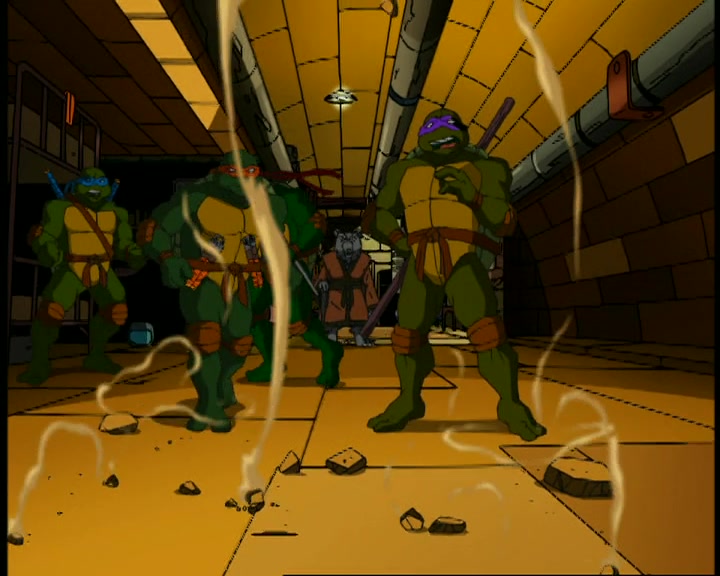
Going Back to the Sewer: How the 2003 Series Found the Comic's Tone
The 4Kids Turtles of 2003 opened with a scene lifted from the first Mirage issue and spent the next several seasons trying to keep four brothers and their father at the centre of a bigger story.
Read →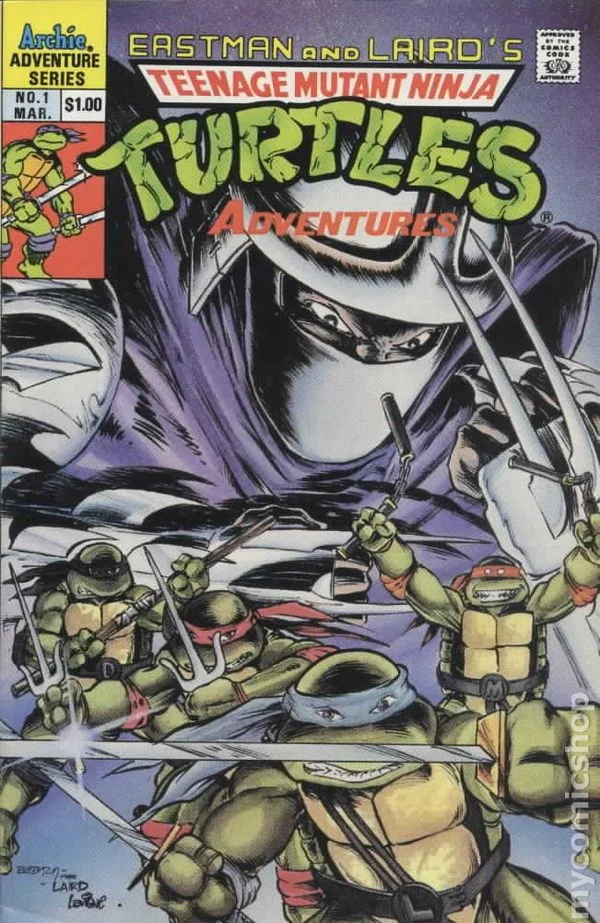 comics
The Turtles Archie Made: A Cartoon Tie-In That Grew Its Own World
Archie's Teenage Mutant Ninja Turtles Adventures began as an adaptation of the cartoon and became the place where the Turtles' universe got bigger than either the cartoon or the black-and-white book.
Read →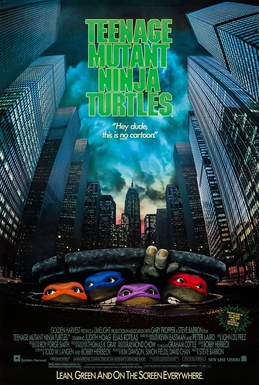 movies
Latex, Fiberglass and a Hong Kong Backer: Making the 1990 Turtles Film
Every big studio passed on a film about four mutant turtles. Jim Henson's Creature Shop built the suits that made the bet pay off.
Read →