
movies
Latex, Fiberglass and a Hong Kong Backer: Making the 1990 Turtles Film
Every big studio passed on a film about four mutant turtles. Jim Henson's Creature Shop built the suits that made the bet pay off.
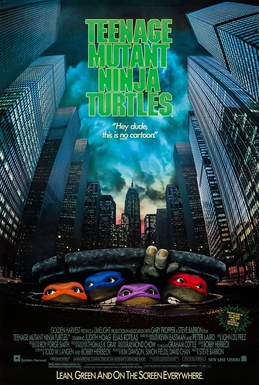
By 1989 the Turtles were everywhere except the cinema, and the people who ran Hollywood were not eager to change that. Accounts of the film’s financing agree that the major studios turned it down. Disney, Fox and Paramount are the names usually given, and the reason attached to them is that four mutant turtles with ninja weapons sounded too odd, too violent and too risky.1 The company that said yes was Golden Harvest, the Hong Kong studio best known for Bruce Lee’s films, and New Line Cinema came aboard later to help pay for it.
What came out on March 30, 1990 was a strange hybrid that should not have worked, a film that took its story from a grim black-and-white comic and its manners from a Saturday-morning cartoon. We tend to credit the script for holding it together, but the script was not the thing. Someone had worked out how to build Turtles that could act!
Two Turtles in one film
The film’s sources are easy to sort. From the Mirage comic it takes the origin story, the rooftop fight, the retreat to a farmhouse and the final battle with the Shredder, and the film draws on both at once. From the 1987 cartoon it takes the coloured bandanas that tell the brothers apart, their love of pizza, aspects of Michelangelo’s personality, and April O’Neil as a television reporter instead of a laboratory assistant.2 Splinter is Hamato Yoshi’s pet rat, and Shredder is Oroku Saki.
The credited writers are Todd W. Langen and Bobby Herbeck, with Herbeck also credited for the story, and the director was Steve Barron, a British music-video veteran best known for a-ha’s “Take On Me.” That choice is worth a second look. A pop-video director has spent a career making a fantasy look convincing on a small budget and a short schedule, and a film about creatures living in a sewer needed that skill at least as much as it needed an action specialist.
The budget was modest, and the production was staged in North Carolina to stand in for the subways and sewers of New York, with location work in the city itself during the summer of 1989.3 The Hong Kong connection showed up on the floor too. The fights were choreographed by Hong Kong stuntmen, and leaner suits were made for the martial arts scenes.
What the suits are for
Put plainly, the 1990 film is a film about faces. A Turtle story lives or dies on whether four creatures with identical shells can be told apart as characters, and in live action that is not a matter of dialogue or design alone. A man in a rubber suit is a man in a rubber suit unless the face can do something, and so the film’s quality was decided in a workshop in London before anyone shot a frame.
Jim Henson’s Creature Shop built the suits in London. The work ran from fiberglass body casts to clay sculpts to moulds and finally to foam-latex skins, and it was done in eighteen weeks.4 The masks had animatronic mouths, eyes and eyebrows, driven by a technician with a joystick and a camera-equipped helmet. The shop was coming off Labyrinth and The Dark Crystal, and Henson reportedly called these the most advanced creatures he had worked with.
That a suit could be expressive did not make it comfortable. A suit that can emote is not a comfortable suit. The four performers were David Forman as Leonardo, Leif Tilden as Donatello, Josh Pais as Raphael and Michelan Sisti as Michelangelo, and they worked through a hot production inside heavy latex, looking out through the mouth.5 The film splits body from voice. Brian Tochi voices Leonardo, Corey Feldman voices Donatello and Robbie Rist voices Michelangelo, but Pais plays Raphael in the suit and speaks for him as well. Kevin Clash, the puppeteer later known for Elmo, performs and voices Splinter, and James Saito wears the Shredder armour while David McCharen supplies the voice.
The argument the suits win
It is fair to ask whether the two tones could ever have lived together, and for a film this strange the answer is that it came close to failing. A parody of grim vigilante comics and a cartoon built for Saturday mornings pull in different directions, and an audience that came for one might have been put off by the other. The film does lurch, since it is a PG-rated picture that includes Splinter being tortured and still finds room for the pizza (we would not have it any other way).
What carries the audience across that gap is the faces. When Splinter sits still and the camera stays on a puppet that is visibly thinking, the film earns the right to be as serious as the comic. When Michelangelo’s face reacts to a joke, it earns the right to be as silly as the cartoon. Without the animatronics the swing between the two would look like a mistake; with them it looks like a personality. Henson’s workshop did the unglamorous work of making that believable.
Release, money and an awkward date
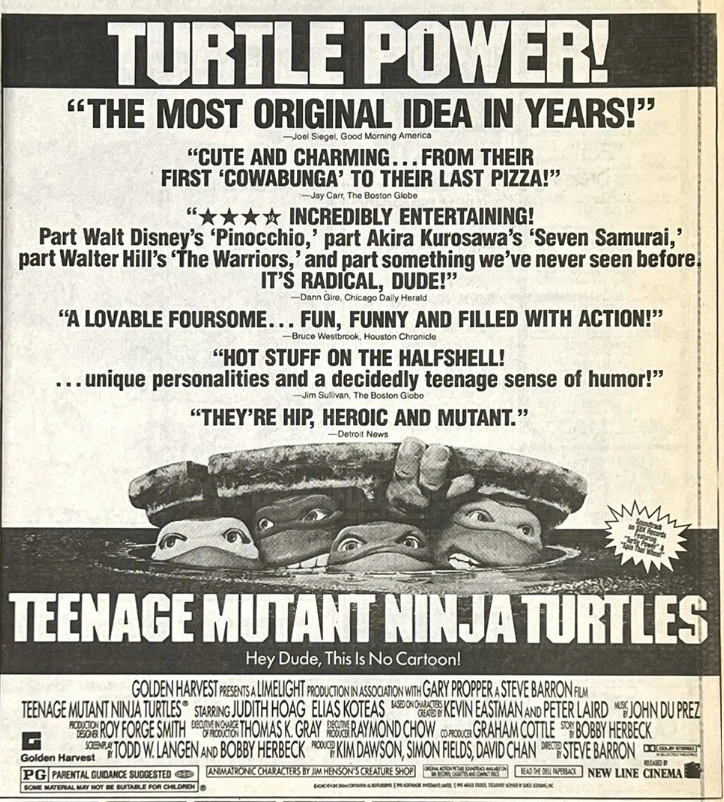
The film opened on March 30, 1990. It had the biggest opening weekend an independent film had seen to that point, and it went on to gross more than $200 million worldwide.6 It finished 1990 as the ninth-highest earner of the year. Pizza Hut ran a large promotional campaign around it even though the pizza in the film itself was Domino’s.
Jim Henson died on May 16, 1990, a few weeks after the film came out, and sources describe the Turtles as his last studio project.7 That gives the suits a different weight now, since they are one of the last things his company delivered while he was alive. A sequel, The Secret of the Ooze, followed in 1991 and inherited both the suits and the question of how serious to be.
The UK release had its own history. The British version hid or removed the nunchaku, cut a scene in the garbage truck, and changed the word “ninja” to “hero” in the “Turtle Power” song.8 Nerves about the premise did not stop at the studio doors, and it makes the achievement look larger that the film got made at all.
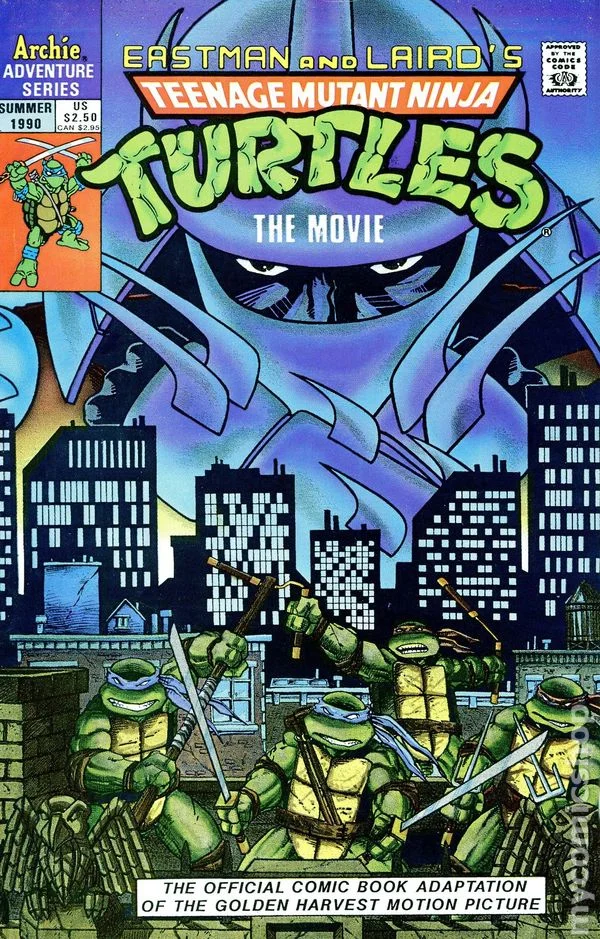
You can read more on the film’s own page, and Mirage’s comic tie-in is in the catalogue under the 1990 movie adaptation. Kevin Eastman appears in the film himself, briefly, as a garbage man.
Footnotes
-
The studio names and the reasons for the refusals are from the Cinema Scholars retrospective of the film. Wikipedia says that New Line acquired the film about halfway through production, while the retrospective puts New Line’s financing in the last days before cameras rolled; we have followed neither date and say only that New Line joined later. ↩
-
The division between comic and cartoon elements is from the Wikipedia article on the film. ↩
-
Wikipedia gives the budget as $13.5 million in its infobox and $14 million in the text. The Cinema Scholars piece puts the studio in Wilmington, North Carolina; Wikipedia says only North Carolina. ↩
-
The eighteen-week construction time and the description of the animatronic heads are from Wikipedia. Sources disagree about how much the suits weighed, with figures running from about fifty pounds to more than seventy, so we give no number. ↩
-
Cast and voice credits are from Wikipedia. Pais is credited for both body and voice as Raphael. ↩
-
Opening weekend (over $25 million), worldwide gross and the year’s ranking are from Wikipedia. ↩
-
Henson’s date of death is a matter of record. The description of the film as his last project is in Paste’s 30th anniversary piece, and Cinema Scholars calls it his last studio film. ↩
-
The UK changes are from the Wikipedia article on the film. ↩
KEEP READING
MORE FEATURES
 cartoons
Going Back to the Sewer: How the 2003 Series Found the Comic's Tone
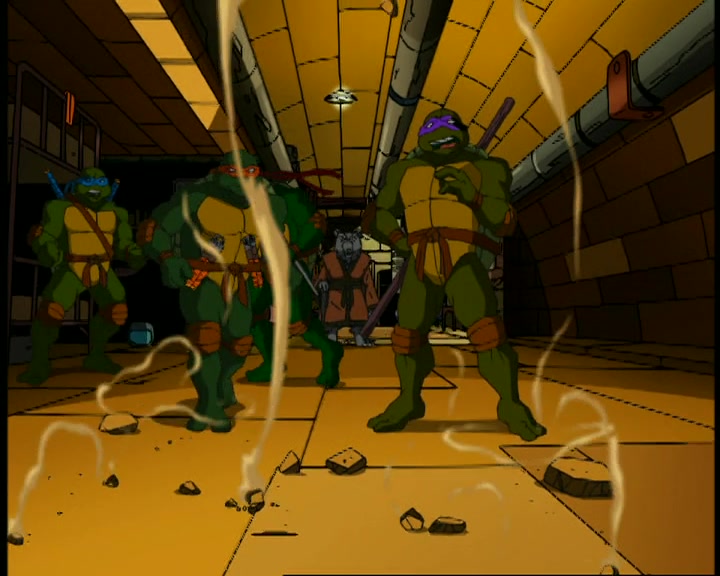
The 4Kids Turtles of 2003 opened with a scene lifted from the first Mirage issue and spent the next several seasons trying to keep four brothers and their father at the centre of a bigger story.
Read → comics
The Joke That Got Out: How Two Roommates Made the Turtles in 1984
A doodle made to get a laugh in a Dover living room, a loan from an uncle, and a black-and-white book that never once explained that it was a joke.
Read → comics
The Turtles Archie Made: A Cartoon Tie-In That Grew Its Own World
Archie's Teenage Mutant Ninja Turtles Adventures began as an adaptation of the cartoon and became the place where the Turtles' universe got bigger than either the cartoon or the black-and-white book.
Read →