
cartoons
Going Back to the Sewer: How the 2003 Series Found the Comic's Tone
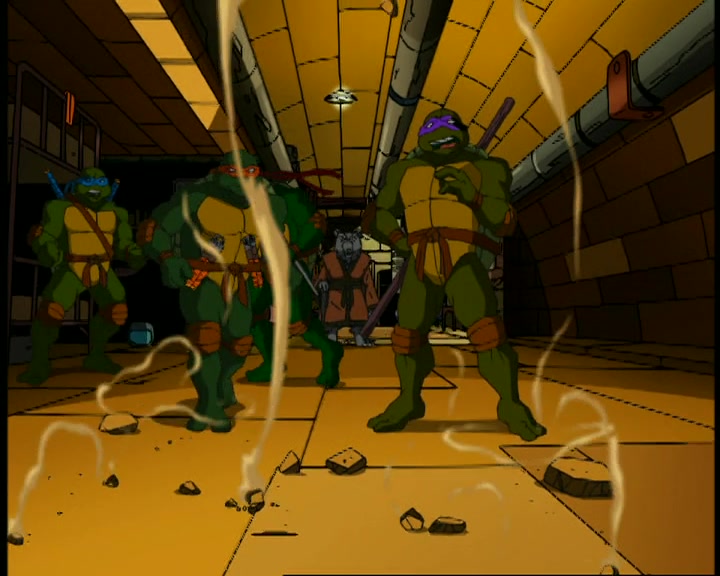
The 4Kids Turtles of 2003 opened with a scene lifted from the first Mirage issue and spent the next several seasons trying to keep four brothers and their father at the centre of a bigger story.
By 2003 the Turtles had been off American television for several years; the last attempt to keep them there, the live-action Next Mutation of 1997 and 1998, had not lasted. The company that took the next try was 4Kids Entertainment, which co-produced the new series with Mirage Studios, the publisher that still co-owned the characters. The result premiered on February 8, 2003, on Fox’s FoxBox block, and it lasted seven seasons.1
The series is described as closer in tone to the original comics than to the 1987 cartoon, with more action and a stronger emphasis on the brothers as a family. The interesting question is how a children’s cartoon with a ratings ceiling can do any of that.
An opening that is a quotation
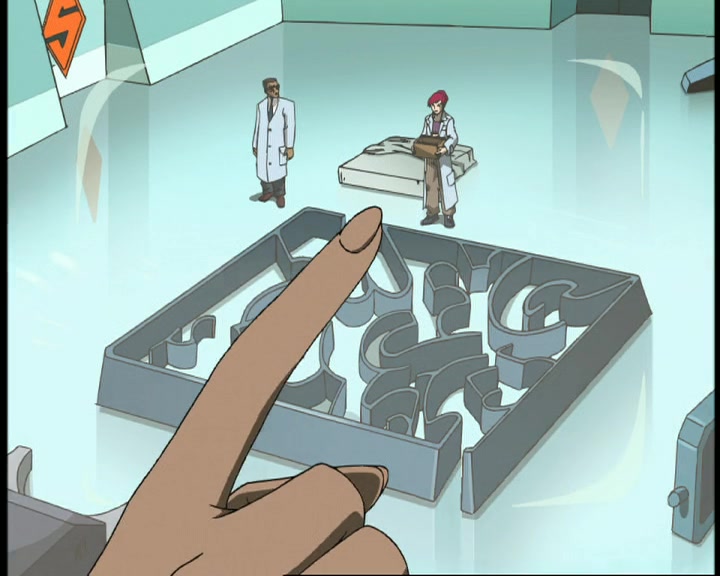
The first episode, “Things Change,” answers by quoting. According to our episode guide, the narration that opens the pilot, with Leonardo speaking over a scene in which the brothers are cornered in an alley by the Purple Dragons, matches the opening of the first Mirage issue.2 The Turtles’ first lair looks like the lair in that book, and the two cops in the episode are modelled on Kevin Eastman and Peter Laird. A second episode, “A Better Mousetrap,” follows the comic issue that introduced April O’Neil and Baxter Stockman, with April discovering that the robot Mousers she helped to design are being built in large numbers for a criminal purpose.
None of that was strictly necessary, but it tells you what the writers wanted. A show that wanted to look like the comic could have borrowed a costume or a colour scheme and left the rest alone. By lifting actual scenes, the series told a particular kind of viewer that the black-and-white book was the source of record, and it did so in the first minutes.
What the show is about
Here is the idea that holds the series together, in plain words: the 2003 Turtles are a family under pressure, and the comic’s seriousness gave that family something real to be under pressure from. The 1987 series was predominantly comic, and its villains were often more silly than frightening. The 2003 series keeps the brothers and the comedy, and puts them in a story where the Shredder is a genuine threat and where Splinter’s past matters.
The writers built Splinter’s past as the show’s foundation. Splinter was the pet of Hamato Yoshi and learned ninjutsu by copying his owner’s movements, and Yoshi was a guardian of the Utroms, an alien race living quietly on Earth, before the Shredder murdered him.3 The Shredder in turn is not one man. Several people carry the title over the series, and the original is the Utrom warlord Ch’rell, who founded the Foot Clan after being stranded on Earth. A second Shredder, in the later Ninja Tribunal storyline, is a demon called the Tengu that merged with the soul of the warrior Oroku Saki. Karai, the Utrom Shredder’s adopted daughter, arrives in the second season and later leads the Foot. Baxter Stockman, the scientist who builds the Mousers that wreck the Turtles’ first lair, belongs to the first season.
The point of all that machinery is to give the family a history that can hurt them, and we think it works. A cartoon family with no past can only squabble, but one with a murdered master, a hidden alien race and a villain who keeps changing faces can be asked to hold together.
Who made it
The series was developed by Lloyd Goldfine, directed by Chuck Patton at the start and by Roy Burdine for the rest, with Susan Blu as voice director in the first five. Eastman and Laird are credited with the characters, and Wikipedia reports that Laird reviewed every outline and draft and approved most of the character designs, while Mirage’s chief executive, Gary Richardson, approved the original pitch.4 The animation was done by Dong Woo. For a series that is often remembered as the television Turtles closest to the book, it is worth knowing that one of the book’s creators was reading the scripts.
Michael Sinterniklaas voices Leonardo, Sam Riegel is Donatello, Wayne Grayson is Michelangelo, and Darren Dunstan voices Splinter. Veronica Taylor voices April O’Neil and Marc Thompson voices Casey Jones.5
One studio, two Turtles
The cartoon was not the only 2000s Turtle from Mirage. The studio’s own comic had been relaunched in 2001, and a Tales of the TMNT anthology followed in 2004, so a reader in the middle of the decade could pick up a black-and-white Turtle book and a Saturday-morning Turtle show from the same publisher. Mirage also produced comic adaptations of the 2007 film, which is the film the cartoon’s last season used as its design model. The catalogue pages for all of these are in the Mirage hub, and reading the comics beside the cartoon is the best way to see where the two agree.
The long road to the end
The show did not keep one shape, and we should say so plainly! The fifth season, “Ninja Tribunal,” was originally meant to be the final one, and it aired later than intended, promoted in 2008 as “The Lost Episodes.” The sixth season, “Fast Forward,” sends the Turtles to the year 2105 with a new art style and a more comic tone, and the seventh, “Back to the Sewer,” redesigned the cast based on the 2007 TMNT film and moved the series to The CW.
The final stretch was poorly received, and Wikipedia’s explanation is partly that 4Kids had to keep the show at a PG rating.6 It is a useful detail to hold on to, since it shows the series working inside a limit from the start. The comic’s gravity kept meeting the broadcaster’s ceiling, and the later seasons are where the ceiling won.
The series ended with Turtles Forever, a television film released in 2009 that crosses the 2003 Turtles with the 1987 cast. By then Laird had sold the franchise to Viacom, so the finale of the show that went back to the comic’s roots arrived just after the people who planted them had let go.
Where to look
Our 2003 series guide has the episodes, with plot summaries, casts and the screencaps from the originals. The Super7 Ultimates line has 2003-series figures, and the black-and-white book the show kept quoting is covered in our Mirage hub.
Footnotes
-
The series ended on February 28, 2009. Premiere and finale dates, the FoxBox and The CW broadcast history and the 4Kids and Mirage co-production are from the Wikipedia article on the series. That article gives 155 episodes over seven seasons. ↩
-
The opening-scene, lair and police-officer notes, and the description of “A Better Mousetrap” as following the Mirage issue that introduced April and Stockman, come from the trivia in our own episode guide. That trivia is drawn from fan-maintained sources and we have not checked it against the original comics page by page, so treat it as reported rather than confirmed. ↩
-
The backstory of Yoshi, Splinter, the Utroms, Ch’rell, the Tengu Shredder, Karai and Stockman is from the Wikipedia article on the series. ↩
-
Staff credits, Laird’s role and Richardson’s approval of the pitch are from the same article. ↩
-
Voice credits follow Wikipedia. Our episode guide’s cast lists differ for Raphael, so we have left him out here. ↩
-
The reception of the sixth and seventh seasons and the rating limit are as reported on Wikipedia. The article says the series was poorly received in those seasons, partly for that reason, and gives no more. ↩
KEEP READING
MORE FEATURES
 comics
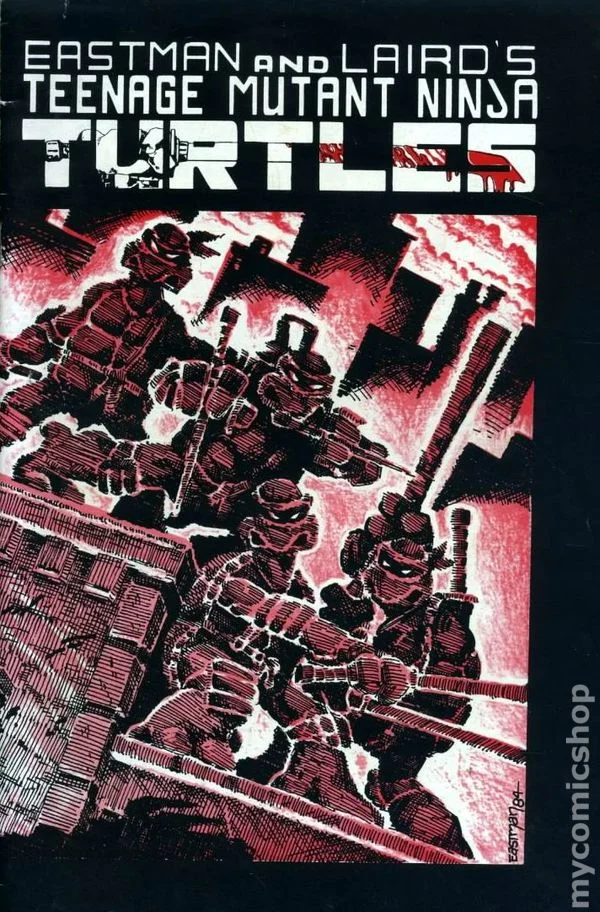
The Joke That Got Out: How Two Roommates Made the Turtles in 1984
A doodle made to get a laugh in a Dover living room, a loan from an uncle, and a black-and-white book that never once explained that it was a joke.
Read →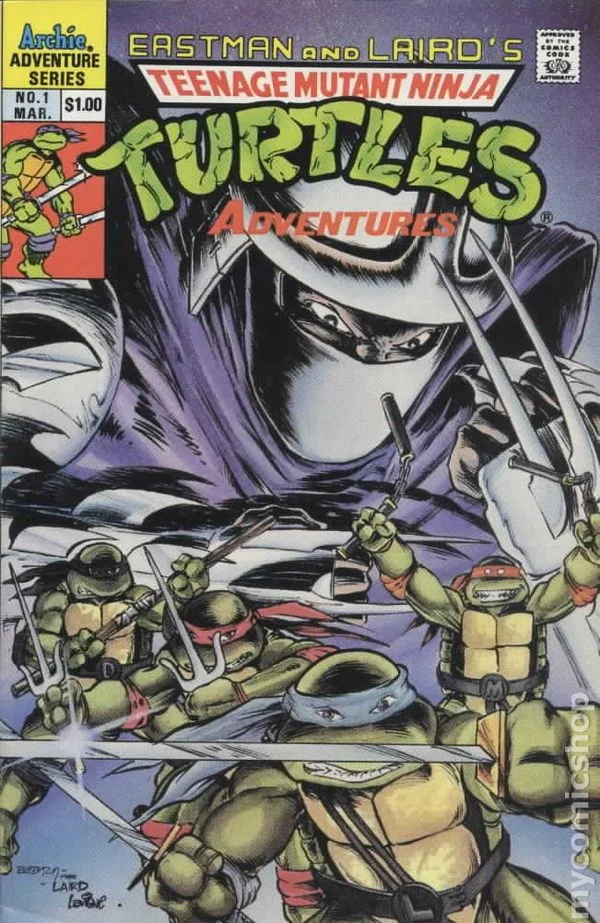 comics
The Turtles Archie Made: A Cartoon Tie-In That Grew Its Own World
Archie's Teenage Mutant Ninja Turtles Adventures began as an adaptation of the cartoon and became the place where the Turtles' universe got bigger than either the cartoon or the black-and-white book.
Read → movies
Latex, Fiberglass and a Hong Kong Backer: Making the 1990 Turtles Film
Every big studio passed on a film about four mutant turtles. Jim Henson's Creature Shop built the suits that made the bet pay off.
Read →